.svg)
On June 12, 2025, Google Cloud Platform (GCP), along with Google Workspace and Google Security Operations, experienced a major outage that impacted customers around the world. The incident lasted just under three hours and disrupted access to some of the most widely used cloud services, including Gmail, Google Cloud Storage, BigQuery, and more. The most severely impacted region was us-central1, where API failure rates for core services approached 100% and persisted for 2 hours and 35 minutes.
Parametrix monitors the real-time service availability of over 7,000 SaaS, PaaS, and IaaS providers. Our system showed that roughly 16% of all providers were experiencing disruptions at varying levels of severity.

While the outage was recorded by Google as a global event, the real story was more nuanced. The impact varied significantly by region, and this regional variance carries deep implications for how businesses understand, manage, and ultimately insure against downtime risk in a highly interconnected digital ecosystem.
The root cause of the outage was traced to a faulty quota policy update in Service Control, a core component of Google’s API management infrastructure responsible for enforcing usage quotas and managing access to thousands of Google APIs.
As a result, customers experienced:
This was not a hardware failure. It wasn’t a data center outage or a case of lost storage. This was a control plane failure, and it struck at the orchestration layer of one of the largest cloud infrastructures on Earth.
From enterprise IT departments to data scientists and security teams, the outage left a wide range of users unable to interact with the services they rely on daily.
At Parametrix, we maintain a proprietary global monitoring network that tracks cloud service performance in real time.
During the June 12 event, our systems observed severe delays and failures in management operations across all monitoring sources. We also picked up a sharp increase in downtime indicators- including in the number of impacted SaaS, PaaS, and IaaS providers monitored by Parametrix and in user reports logged on Downdetector..
Most significantly, as seen in the image below, we recorded dramatic differences in impact across regions. While some regions experienced moderate disruptions, others were hit hard.
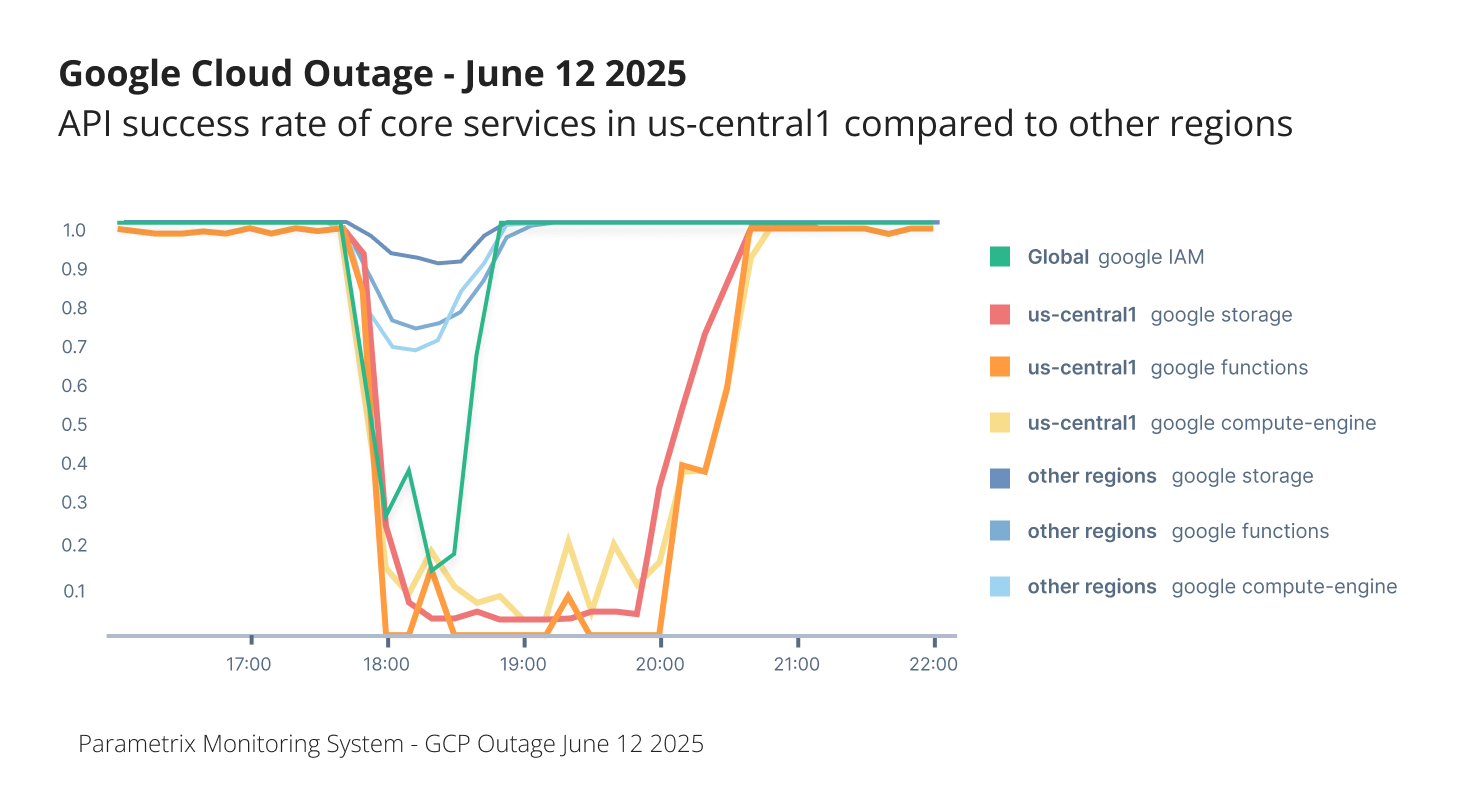
In the GCP’s us-central1 region, Parametrix Monitoring System recorded:
Other regions such as europe-west1 and asia-east1 saw shorter, less severe interruptions, often limited to brief periods of API delay or degraded access. In some cases, existing workloads continued with minimal interruption, and recovery was quick.
Cloud outages are often described as global, but they rarely affect all regions equally. In the case of this GCP event, customers in some regions remained operational, while others faced near-total shutdowns.
This is where parametric insurance comes in. Coverage is built on transparency and precision. When a predefined event, like a specific service failure in a named region, meets the agreed criteria, a payout is triggered automatically. There are no adjusters, no disputes, and no delays. Just fast, objective financial recovery when it’s needed most. Parametric coverage isn’t just fast, it’s purpose-built for the structure of modern cloud ecosystems. By tying insurance protection to actual downtime in specific technologies, businesses can align coverage with the infrastructure they depend on.
Download
.svg)
Read about the latest outage events, industry trends, thought leadership pieces, and more.
A parametric approach to quantifying, managing, and transfering exposure to technology downtime and digital infrastucture risk. Parametrix is a Lloyd's Coverholder whose policies are backed by major A-rated global insurers.


The products and services referred to on this website are available only in the jurisdictions in which we are licensed to transact insurance business. Nothing on this website shall be construed as an offer or solicitation to purchase insurance in any other jurisdiction. The availability, terms, and conditions of such products and services may vary by jurisdiction. The list of licenses held by Parametrix Insurance Services LLC as an insurance producer and surplus lines broker in the US states can be viewed on our license page. Parametrix provides insurance products in connection with potential downtime on services represented by brands which this website displays. Parametrix is not affiliated to, associated with, or sponsored by the owners of these brands.
.svg)