

Marsh warns that Data Center SLA breaches could trigger millions inmonthly penalties and near-billion-dollar termination exposure.
Watch the full interview with The Insurer TV.
Marsh highlights SLA risk as one of the “major topics” coming across their desk every day. Clients are increasingly asking how they can manage and insure this exposure as data center growth accelerates across hyperscale and colocation markets. In response to this demand, Marsh is collaborating across multiple internal teams including construction, energy property, and cyber to understand the exposure and structure solutions that address the evolving needs of digital infrastructure clients.
As data centers become more critical to AI, cloud and enterprise operations, uptime commitments are becoming a material financial risk. Data center operators are contractually tied to uptime commitments, often around 99.99% availability, covering power delivery, electricity, temperature and humidity controls. If these standards, which are governed in Service-Level Agreements (SLAs) are breached, operators are required to pay financial penalties to the tenants, who may even have a right to terminate the lease agreement.
These losses, which can reach around $5M per month, expose the data center to risks that are not covered by traditional insurance solutions. These risks are high-impact and operational with potential exposure across cyber, property, energy, construction and contractual liability. Insurers and reinsurers are trying to understand what information they need to underwrite these exposures and how much capital should be allocated to the risk.
Marsh highlights how Parametric solutions are a possible way to address this gap, where coverage could be triggered by measurable outage events or SLA failures, rather than relying on traditional claims adjustment.
Download Parametrix's white papers, an Introduction to data center SLAs and the impact SLA exposure has on valuation and financing, for a deeper look into how SLAs are structured, the financial exposures they create, and why they have become an increasingly important consideration for data center operators, investors, lenders, and insurers.
Neo Clouds: A New Operator with New Risk Implications
Neo Clouds represent a fundamentally different risk profile from traditional data center operators, yet many investors and insurers continue to evaluate them as though they carry the same operational risk profile. Unlike standard data centers that are primarily responsible for power, cooling, and connectivity, Neo Clouds are also liable for GPU performance and compute availability – creating significantly higher operational and SLA exposure. Even minor GPU outages can trigger a “double loss” effect, where operators do not just face contractual SLA penalties, but lose revenue on unavailable compute.
Additionally, Neo Cloud operators manage tens of thousands of GPUs in concentrated environments with less redundancy than hypserscalers like AWS and Microsoft, and so the underwriting assumptions based on near-perfect uptime are unrealistic.
As the sector grows, both insurers and capital providers will need more specialized underwriting models that properly account for compute reliability, operational interruption risk, and the financial implications of GPU downtime, alongside SLA-triggered losses, tenant concentrations and fast hardware replacement needs.
Check out this McKinsey report for more information on Neo Clouds.
Delayed Projects and The Insurance Evolution
Satellite imagery from the geospatial data analytics company, SynMax, shows construction delays for 40% of projects planned for 2026, including those of major projects from tech companies such as Microsoft, Oracle and OpenAI that are likely to miss completion dates by more than three months.
Reasons cited include shortages of labour, power and equipment, as well as community resistance and supply chain issues due to tariffs on imported Chinese transformers. Developers are beginning to use mobile gas generators on semi trucks and turbines that were originally designed for aircraft and warships, further complicating operational risk.
This highlights the increased complications of these projects and we are seeing that insurance is increasingly being used to help support lenders and investors gain comfort with the development risk - both in the construction and site selection phase. Thus rather than being implemented as a balance sheet protection tool, insurance is transitioning to the front end of project planning. We see that insurers are being brought into land acquisition conversations and power plant discussions to identify and solve for the risks. The insurance industry is needing to adapt, solve for gaps in the current product-market fit and develop solutions for the whole life cycle management of data center construction to stabilization and then operation.
Data center outage in AWS us-east-1 cloud region on May 7
A failure at a single data center in the AWS us-east-1 region on May 7, 2026 was an interesting example of how outage duration doesn’t always equal outage severity.
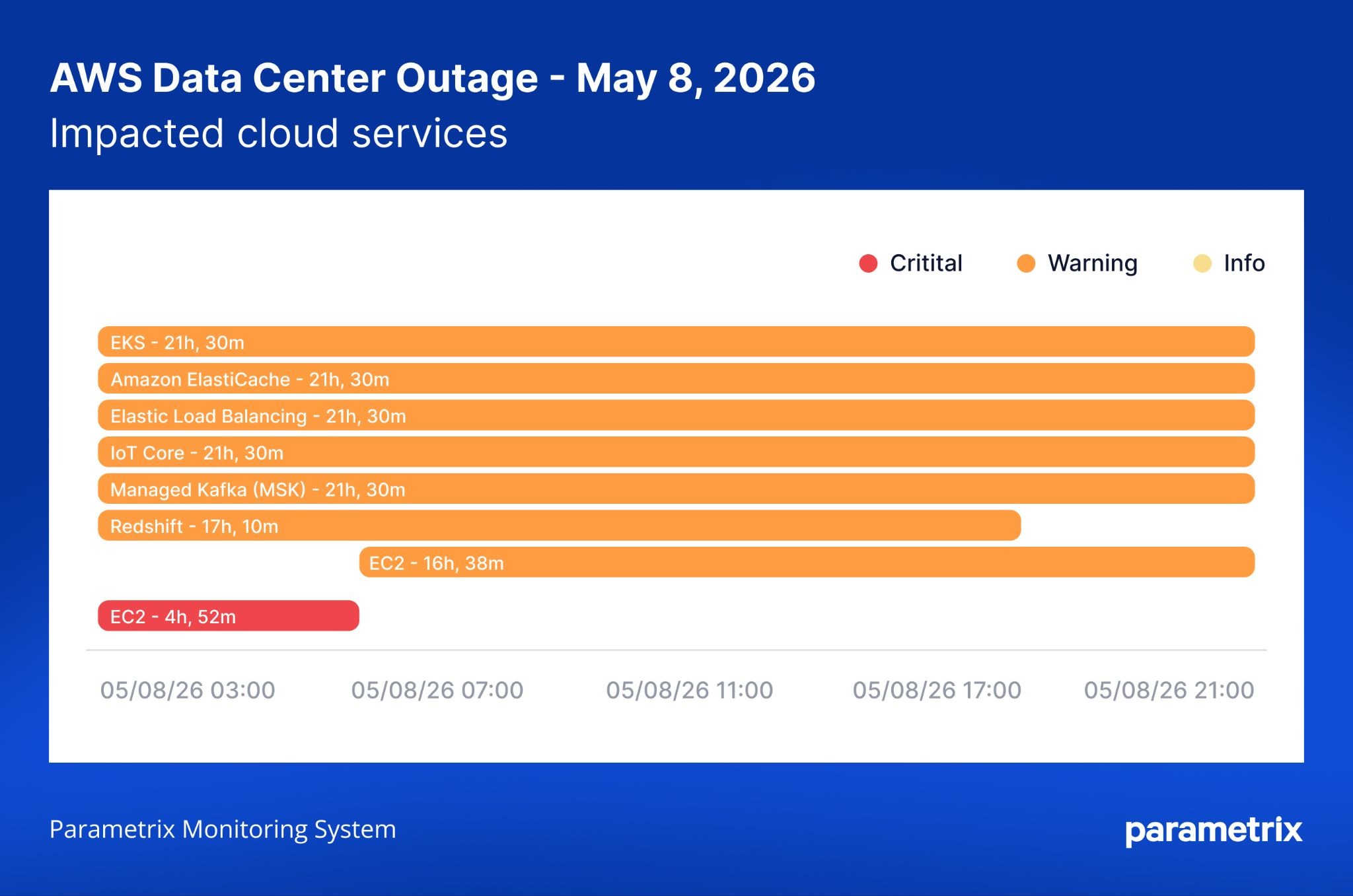
While power was restored after roughly five hours, full recovery took approximately 21.5 hours. Despite the long recovery window, the overall customer impact in the region appears to have been relatively limited.
Why? Because the event was highly contained- impacting only a portion of a single data center within one Availability Zone inside the us-east-1 region.
At Parametrix, our monitoring systems run multiple machines in the impacted zone, and only one was affected during the event. This reinforces how localized the disruption actually was and confirms the impact of the incident.
One of the most visible exceptions was Coinbase, whose centralized exchange experienced several hours of disruption. As Coinbase later explained, parts of its architecture did not include zonal redundancy in the AZ in order to optimize for latency and client co-location. The company stated that outages of this nature are “entirely unacceptable” for a platform handling billions in daily trading volume.
Most organizations operating in US-EAST-1 build redundancy into their architecture precisely because it is the world’s largest cloud region, and one with a long history of outages that have created widespread downstream impact across the global digital economy.
The outage impacted core services and triggered cascading disruptions across multiple dependent AWS services such as ELB, EKS, ElastiCache, Redshift, OpenSearch, MSK, IoT Core, and NAT Gateaway, with elevated error rates and latencies for some workflows and configurations.
.svg)