

The data center industry has transformed into a foundational pillar of global digital infrastructure, driven by increasing demand for cloud services and AI capacity. Morgan Stanley estimates that data centers will need about $1.5 trillion of investment-grade financing over the next five years to meet this demand. For investors, the appeal of this asset class is its combination of real estate fundamentals (physical assets, location and power-grid dependency) with infrastructure-like stability (critical digital services and persistent demand). However, as capital requirements increase, the sector is becoming more reliant on institutional and long-term investors who prioritize predictable and stable cash flows.
At the same time, hyperscaler customers require strict Service-Level Agreements (SLAs) with financial penalties tied to uptime performance. While these agreements reinforce operational discipline, they also create financial exposure for owners/ operators. SLA breaches as short as 26 seconds can trigger immediate financial penalties. These penalties often come in the form of service credits or rent abatements ranging from 100% to 200% of Monthly Base Rent (MBR), effectively functioning as a variable operating expense that can erode net operating income. In severe cases, a breach can trigger lease termination rights, potentially leaving a facility entirely empty with zero revenue.
The penalties and potential lease termination introduce cash flow volatility that can affect valuation, leverage and debt service coverage - particularly as stabilized data center assets are increasingly used as collateral for new development financing. Addressing this exposure is becoming important to maintain the investment profile required by institutional capital and lenders. One approach is SLA insurance, which transfers the financial exposure of performance breaches and helps stabilize cash flows.
The cost of SLA penalties
Once a data center becomes operational, Service-Level Agreements (SLAs) with tenants define required standards for uptime, power, communication and environmental conditions. Unlike traditional operating expenses, SLA penalties (that are non-discretionary and contractually enforced) can be triggered by brief performance deviations. Operational disruptions as short as 26 seconds can result in penalties in the form of tenant credits, rent abatements or in extreme cases, lease termination.
While SLA structures vary by tenant and contract type, under standard hyperscaler and enterprise colocation contracts, penalties for outages are often calculated as a percentage of Monthly Base Rent (MBR). Depending on outage severity and duration, agreements could include:
- Service credits ranging from approximately 100% - 200% of MBR
- Enhanced penalties for critical connectivity outages - potentially reaching several multiples of MBR or up to one year of rent
- In severe or repeated breach scenarios, the tenant has termination rights, which if exercised, could leave a data center empty without any revenues
The financial impact- use case
Consider a standard operating data center that generates $144 million in annual rent, yielding an annual Net Operating Income (NOI) of $86.4 million and an annual cash flow of $57.6 million.
Under a typical hyperscaler SLA requiring 99.99% uptime, an outage lasting just 45 minutes can trigger a 100% Monthly Base Rent (MBR) service credit. This single, brief disruption results in a $12 million penalty, instantly wiping out 20.8% of the facility's annual cash flow. If the facility operates under a more punitive SLA where credits reach 150% of MBR, that same 45-minute outage results in an $18 million penalty, eroding annual cash flow by a staggering 31.8%.
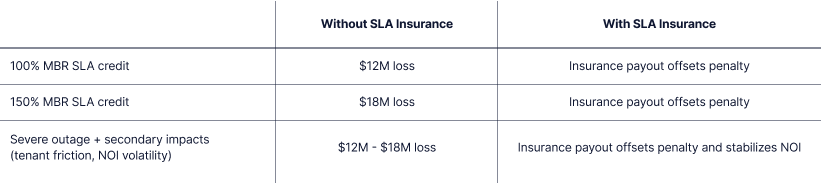
Because data center valuations are fundamentally driven by the income they generate, these massive and sudden cash flow reductions not only directly impact the asset’s net operating income, but also weaken the asset’s credit profile and valuation. Since stabilized assets are often pledged as collateral for new development loans, SLA‑driven volatility amplifies financing risk. Moreover, a history of solid operating performance is a critical element to refinance data center assets successfully.
To learn more about SLA exposure and how SLA insurance serves as a financial instrument to enhance data center financeability and valuation, download Parametrix’s whitepaper on The Impact of SLA Exposure on Data Center Valuation and Financing.
.svg)